
The bleep was never the problem
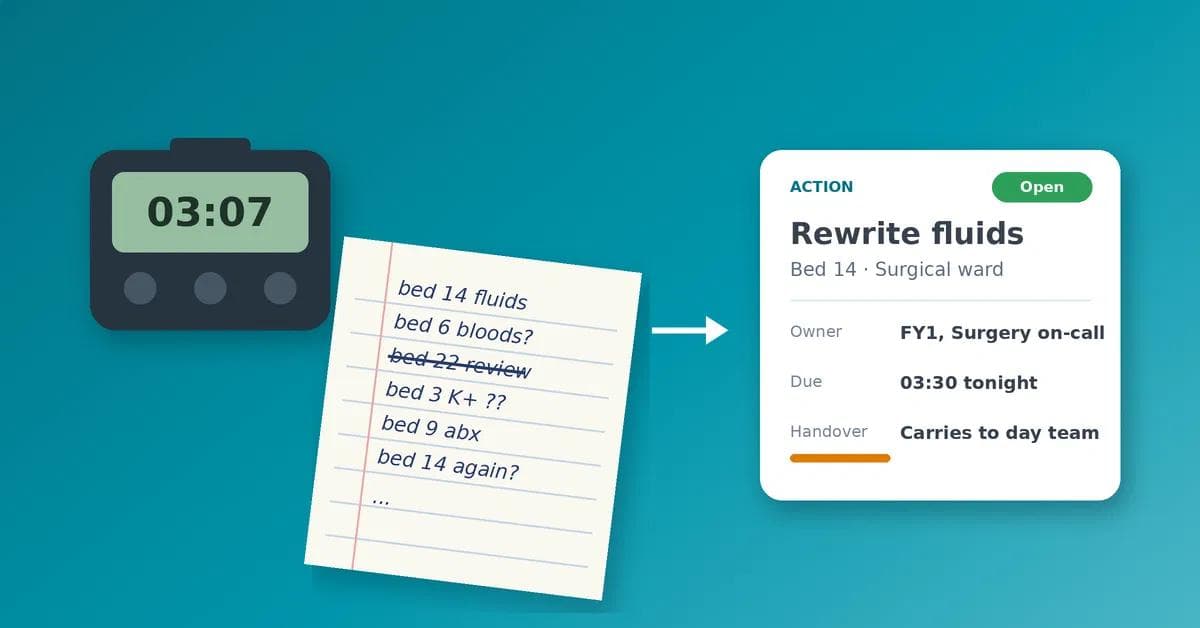
It's 3am. A nurse bleeps the junior doctor covering the surgical wards: bed 14 needs its fluids rewriting. The doctor is halfway through a cannula on another floor. Ten minutes later they find a phone, call back, and scribble "bed 14 fluids" on the back of their handover sheet.
By 5am there are nine notes like that. One gets missed. Nobody can say which, because the only record of any of them is a folded piece of paper in a scrub pocket.
The alert isn't what puts that patient at risk. It is the work created, and the fact that the work lives nowhere. That matters now, because NHS trusts replacing their bleeps are mostly buying faster, smarter ways to send the message. Far fewer are fixing what happens after it lands.
The short answer
- What is wrong with hospital bleeps? They interrupt without context, but the bigger risk is that the tasks they trigger are agreed by phone and recorded nowhere.
- Do clinical communication platforms fix it? They fix the alert: requests arrive with context, go to the right role and escalate if nobody answers. But they are built around the message. The task inside it still needs an owner, a due time and a place to live through handover.
- What should replace a bleep? A system where every request becomes a task with a patient, a named owner and a due time, visible to the whole team and carried through handover.
The work behind the bleep
A bleep tells you something is happening. It doesn't tell you what's happening now, what needs to happen next, or who is responsible.
Behind almost every non-emergency bleep is a piece of work: review this patient, chase that result, write up these fluids. The bleep starts a chain of phone calls and scribbled notes. The work itself is recorded nowhere until it is done, and sometimes not even then.
That is why bleeps hurt most out of hours, when a small hospital at night team covers hundreds of inpatients. The risk isn't the alert. It is the task that was agreed on the phone and never written down.
So a good replacement has to answer three questions for every request:
- What is happening now? The request, the patient and the urgency, visible before anyone picks up a phone.
- What happens next? The task, with a due time.
- Who is responsible? A named owner, who stays named through handover.
Faster alerts are not the same as finished work
Some trusts replacing bleeps are choosing clinical communication platforms, and they are a real step up. Messages go to a role rather than a pager number. They arrive with context, escalate if nobody answers, and break through for emergencies. Some connect to the EPR and switchboard.
But they are built to get the right message to the right person, fast. Once the message lands, the work it describes still has to be tracked somewhere. At 3am, that somewhere is often still the back of a handover sheet. The difference is what each one actually records:
Bleep - That someone wanted you
Clinical communication platform - What was said, to whom, and whether they replied
CAREFUL - What needs doing, for which patient, by whom, by when, and whether it's done
CAREFUL is built around the action, not the message. You still get secure team messaging and emergency calls. But any request becomes a tracked action in two clicks: @mention a colleague, link the patient, set a due time. The action has a named owner, shows on the patient's record, sits in one team-wide list of outstanding work, transfers at handover and closes with an audit trail. It works across organisations too, which matters more as care moves into neighbourhood teams.
At Hywel Dda University Health Board, this saved doctors 30–60 minutes per shift on the acute medical take. At Withybush Hospital, referral time between teams fell from 22.5 minutes to under one minute. The details are on our evidence page.
Why this matters now
In 2019, NHS trusts in England were told to remove pagers for non-emergency use by the end of 2021. The NHS was then using around 130,000 of them, more than one in ten of the world's pagers. The deadline was widely missed, held back by patchy Wi-Fi, emergency-call safety, devices and habit.
Now a second wave is under way. Trusts are tendering for replacements, going live with clinical communication platforms, and renewing old pager contracts a year at a time while they decide. There is even a dedicated framework lot for pager replacement, worth around £13.5 million.
Each of these decisions is a chance to fix the 3am problem, or simply to send it faster. We looked at why bleeps have lasted so long in The enduring challenge of bleeps in healthcare.
What about crash and emergency bleeps?
The 2019 instruction covered non-emergency pagers only. Trusts were allowed to keep pagers for emergencies, and many still do.
That is changing too. Some trusts now send crash calls digitally as well.
CAREFUL's emergency calls send audited critical alerts to on-duty responders for crash calls, peri-arrest, major incidents and other emergency types a trust defines. They can be raised by any clinician or by switchboard, and the 2222 route keeps working alongside. Trusts can move emergency calls at their own pace, after non-emergency traffic has moved over.
Five questions to ask before you replace your bleeps
Whether you are writing a specification or comparing suppliers on the framework, test each option against these:
- When a request arrives, does it become a task with a named owner and a due time? Or does it stay a message?
- Can the whole team see what's outstanding right now, across wards and specialties?
- Do open tasks transfer at handover, or does the night team start from a blank screen?
- How are emergency calls handled, and how does the system work alongside switchboard and 2222?
- Does it meet NHS assurance standards? Look for DTAC, DSPT, Cyber Essentials Plus and a DCB0129 clinical safety case. CAREFUL's are listed on our DTAC page.
If an option only answers the first half of question 1, it will replace the bleep but not the chasing.
Replace the chasing, not just the bleep
The nurse at 3am doesn't need a better pager system. She needs to know her request landed, who owns it and when it will be done. The doctor needs a list, not a pocket full of notes. And the morning team needs to inherit the night's open work, not reconstruct it.
If your trust is planning a bleep replacement, we would be glad to show you how CAREFUL works on a real shift. Book a call or read more about bleep and pager replacement.
Frequently asked questions
What is the real problem with hospital bleeps?
The interruption is only part of it. The bigger risk is that most bleeps trigger a task, such as reviewing a patient or rewriting fluids, that is agreed by phone and recorded nowhere. Tasks get lost, especially overnight, when a few doctors cover hundreds of patients.
Are NHS hospitals still using bleeps in 2026?
Yes. Despite a 2019 instruction to remove non-emergency pagers by the end of 2021, many NHS trusts still use bleeps. Several are tendering for or rolling out replacements in 2026.
What are NHS trusts replacing bleeps with?
Mostly clinical communication platforms: secure apps that send messages and alerts to staff by role, with escalation and, increasingly, emergency alerting. Some trusts also add task management or clinical coordination tools to manage the work those messages create.
Did the NHS ban pagers?
In February 2019, the Health Secretary told NHS trusts in England to stop using pagers for non-emergency communication by the end of 2021. Pagers could still be kept for emergencies. The deadline was widely missed.
How do NHS trusts buy a bleep replacement?
Many use the NHS Commercial Solutions Patient and Healthcare Communications framework, which has a dedicated lot for medical messaging applications (pager replacement). Trusts can also run their own procurement.
What is the best replacement for hospital bleeps?
The best replacement does more than deliver messages. It turns each request into a tracked task with a patient, a named owner and a due time, shows outstanding work to the whole team, and carries tasks over at handover. Emergency alerting should be covered too.
How is CAREFUL different from a clinical communication platform?
Clinical communication platforms are built around getting messages and alerts to the right person. CAREFUL is built around the work: every request becomes an action linked to a patient, with a named owner, a due time and a status, visible to the whole team and carried through handover. It includes secure messaging and emergency calls as well.
Can bleeps be replaced for emergency calls?
Yes. Some trusts now send crash and major incident alerts digitally. CAREFUL's emergency calls send audited critical alerts to on-duty responders, raised by any clinician or by switchboard, with the 2222 route working alongside.
Sources
The CAREFUL team
Author
Related Articles

Are we seeing Innovation for All?
Despite the fanfare of digital transformation, many NHS technology programmes still fail to scale

The EMR was built around billing. That's been bad for patients and staff.
Most clinicians now spend more of their working day at a screen than with patients. This is not by accident. It is by design. An immediate and radical shift of perspective is needed to improve the digitisation of healthcare.
What's the difference between an EMR, EPR and EHR?
EMR, EHR, EPR — three acronyms, endless arguments, and no one fully agrees. The real reason for the confusion isn't complexity — it's geography. But beneath the jargon sits a bigger question, one your record system was never built to answer.