
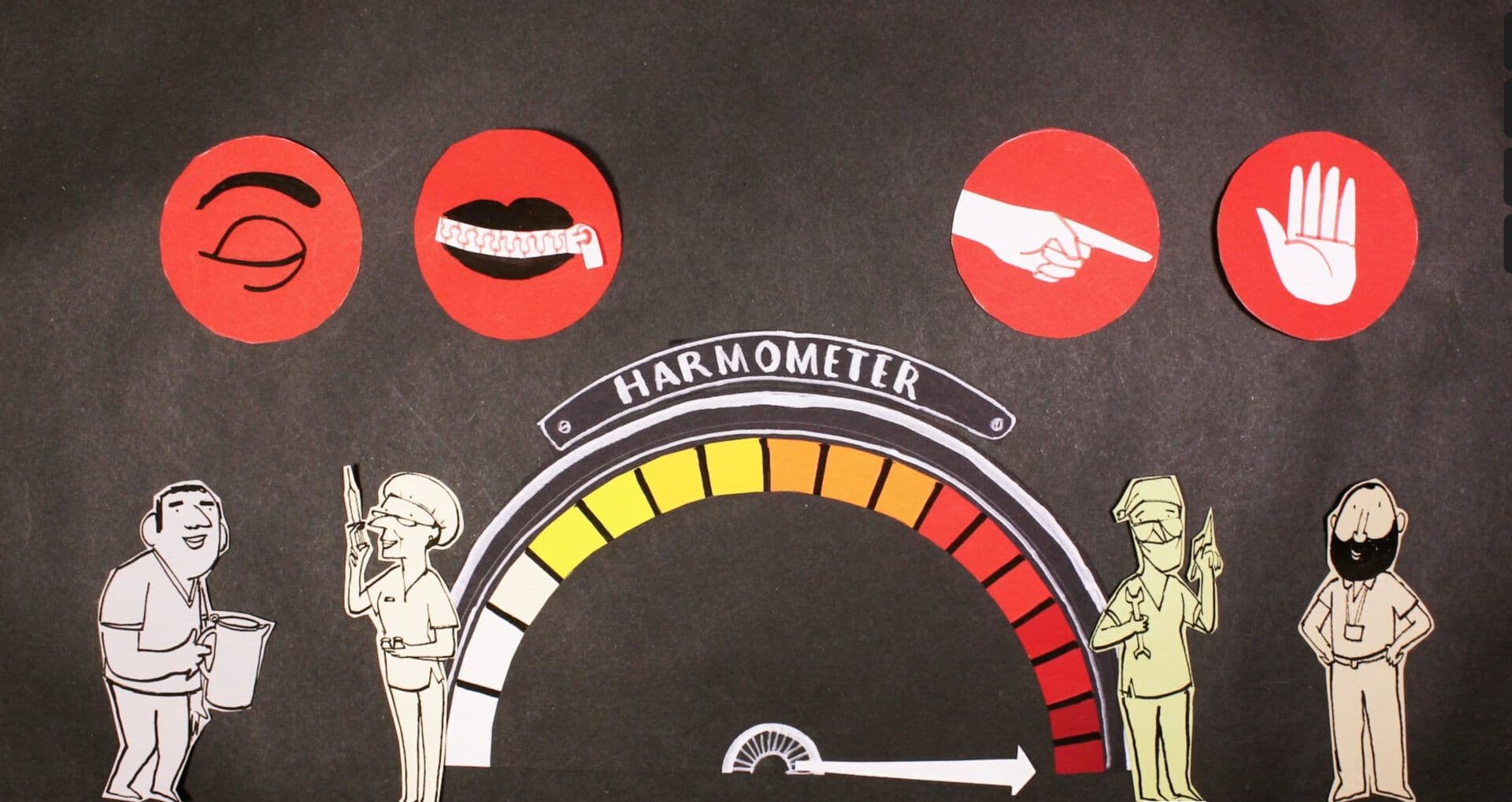
How to engage all staff to improve patient safety culture: The STEP-up programme
Why is patient safety culture important?
The difference between safe and unsafe practice in healthcare is primarily one of culture3–5.
If culture is primarily demonstrated in behaviour, then a culture of safety in healthcare is defined by the behaviour of staff when they recognise and respond to risk.
Developing such a culture must therefore revolve primarily around developing the skills and willingness to report issues, discuss or confront problems, and to become involved in system improvement5.
However, research clearly shows that staff have little understanding, or affinity for, the term ‘patient safety culture’6.
To solve this conundrum, STEP-up sets out to engage healthcare staff in a programme of awareness building, motivation and empowerment that in turn leads to a reduction in the incidence of avoidable harm and an improved patient safety culture.
Watch the film
https://player.vimeo.com/video/718237642?dnt=1&app_id=122963
What is STEP-up?
STEP-up is a structured programme to improve the culture of patient safety.
It creates great results – and it's fun!
We describe it below in summary – and also in our write-up here: https://journals.sagepub.com/doi/10.1177/2516043518792180
The programme was initially run at Aspen Healthcare, by Dr DJ Hamblin-Brown and Ms Judi Ingram. It has subsequently been run at United Family Healthcare in China.
The programme measurably reduced patient harm by engaging staff in a programme to improve the culture of patient safety.
STEP-up delivers spectacular results
In Aspen, we worked with all 1500 staff, across nine sites, during a 12-month period. We used the short film (above) and a four-level programme of training and development (described below), which included elements specifically aimed at sustaining cultural changes.
The results were substantial:
- 95% reduction in never events
- 77% reduction in serious incidents
- 38% fewer falls with harm and
- 19% fewer falls overall
- 24% increase in incident reporting
Overall, the number of incidents with harm has fallen by 5%. Staff perception of our organisation as ‘extremely’ or ‘very’ safe has increased from 73% to 77%. The financial cost of this has been modest and has, we estimate, been recouped in reduced cost of serious incidents. We make the case that a programme such as this is possible, at minimal cost, in any healthcare organisation. Given the results, we argue that all healthcare leaders have a duty to implement something similar.
The four components of patient safety culture
STEP-up is structured around four broad components, based on longstanding research5 that we felt best comprised a culture of safety, namely:
- ****Reporting** – recognising and identifying both actual incidents and opportunities for harm or near misses**
- ****Openness** – talking about patient safety issues with- out fear of recrimination or blame, and to make this part of the normal conversation within the organisation;**
- ****Justice** – ensuring that error is seen and treated as a product of the environment, context, and system, and not about individual culpability; and**
- ****Improvement** – creating the desire, capacity and capability to change the organisation’s systems and context to make error less likely in the future.**
The STEP-up approach
The four principles of STEP-up (outlined in our paper), are as follows:
- **Visit and talk with everyone** – and that meant everyone – personally to ensure that they realised this included them whatever their roles, clinical and non- clinical staff
- **Work in particular with first-line leaders**, upon whom a safety culture is critically dependent
- **Address the highest risk issues**, where patient harm could be most severe
- **Ensure sustainability** through local resources
For more information about STEP-up, please contact us at hello@careful.online.
References
1\. Makary M, Daniel M. Medical error—the third leading cause of death in the US. BMJ. 2016;:i2139.
2\. de Vries E, Ramrattan M, Smorenburg S, Gouma D, Boermeester M. The incidence and nature of in-hospital adverse events: a systematic review. Quality and Safety in Health Care. 2008;17(3):216-223.
3\. Graban M. Lean hospitals. 3rd ed. Boca Raton: CRC Press; 2016.
4\. Vincent C. Patient safety. 2nd ed. Chichester: Wiley-Blackwell; 2010.
5\. Reason J. Managing the risks of organizational accidents. London: Routledge Taylor & Francis Group; 1997.
6\. Ingram J. Exploring staff perceptions of a patient safety culture \[Unpublished MSC Thesis\]. University of Westminster; 2015.
7\. Greenlions Ltd. How to Harm Patients … and how not to \[Internet\]. 2015 \[cited 23 June 2018\]. Available from: https://greenlions.com/projects/improving-patient-safety-aspen-healthcare/
8\. Morrison D. Chief of Army Lieutenant General David Morrison message about unacceptable behaviour \[Internet\]. 2013 \[cited 23 June 2018\]. Available from: https://www.youtube.com/watch?v=QaqpoeVgr8U
9\. David Morrison – Wikiquote \[Internet\]. En.wikiquote.org. 2018 \[cited 23 June 2018\]. Available from: https://en.wikiquote.org/wiki/David\_Morrison
10\. Never Events list 2018 \[Internet\]. London: NHS Improvement; 2018 \[cited 23 June 2018\]. Available from: https://improvement.nhs.uk/documents/2266/Never\_Events\_list\_2018\_FINAL\_v5.pdf
11\. Hospital Survey on Patient Safety Culture \[Internet\]. Ahrq.gov. 2018 \[cited 23 June 2018\]. Available from: https://www.ahrq.gov/sops/quality-patient-safety/patientsafetyculture/hospital/index.html
DJ Hamblin-Brown
Author
Categories
Related Articles

Are we seeing Innovation for All?
Despite the fanfare of digital transformation, many NHS technology programmes still fail to scale

The EMR was built around billing. That's been bad for patients and staff.
Most clinicians now spend more of their working day at a screen than with patients. This is not by accident. It is by design. An immediate and radical shift of perspective is needed to improve the digitisation of healthcare.

What's the difference between an EMR, EPR and EHR?
EMR, EHR, EPR — three acronyms, endless arguments, and no one fully agrees. The real reason for the confusion isn't complexity — it's geography. But beneath the jargon sits a bigger question, one your record system was never built to answer.